Thursday, July 18, 2013

Used car dealers urge authorities to review car loans curbs


The Singapore Vehicle Traders Association which represents the interests of over 400 used car dealers here is renewing its call for a review on car loan curbs.

It said many dealers have seen sales drop by between 30 and 80 per cent since the 60-day reprieve period ended in early June.

Used car dealers sold most of their stock of about 7,000 cars during the 60-day reprieve period from April 6 to June 4.

Before the loan curbs kicked in, buyers used to be able to take up to 100 per cent loans for car purchases.

Now that they are unable to do so and dealers are feeling the pinch once again.

Raymond Tang, honorary secretary of Singapore Vehicle Traders Association, said: "In July, the situation is very bad. We have made a survey and majority of the dealers are not selling (well)."

Under current rules, buyers of both new and used cars can only get a loan of up to 60 per cent.

The loan period is capped at five years, down from 10 years.

Dealers said sales have also been affected by a smaller supply of used cars in the market as more people hold on to their cars.

Vincent Wong, director of First Automobile Premium, said: "We have actually experienced as much as a 30 to 40 per cent of depletion of sales and generally to us, it is quite an extensive impact. For the dealers to recover their stocks and replenish their stocks, it is quite difficult at this point of time.

Mr Wong added: "For many of these people, they are not able to change and so they are holding on to their cars. The dealers are also very careful in the valuation of cars. They cannot be buying too high and if they do, it will put themselves in a big financial difficulty."

The loan curbs were introduced to encourage financial prudence.

The Singapore Vehicle Traders Association said Certificate of Entitlement (COE) prices are still high in recent bidding rounds.

Prices for both small and big cars were over S$70,000 in the latest bidding round.

The association has proposed that used car buyers be able to borrow up to 80 per cent of loan which can be serviced over eight years. It said the move will help ease COE premiums.

Mr Tang said: "In this way, I feel that it might help to stabilise the COE premiums because they might pull a small group of people from buying a new car to the used car. If there is a small group of people coming over, that might also slow down the demand on the new car.

"Eighty per cent is quite a fair bit because in terms of used car, it is more towards the mass market and middle and lower income people. I think that telling them to fork out at one go of 40 to 50 per cent of down-payment is might be a very heavy amount for them."

The COE quota for the next six month period starting from August this year to January next year will be about eight per cent higher.

However, dealers said it will unlikely to have much of an impact and bring down COE prices significantly."

The association intends to submit its proposal to the Monetary Authority of Singapore this month.

SOURCE

I'm surprised these dealers are still alive to make some noises. After the 60-day rule suspension, I had expected them to fold up or switch to other automobile related business but they actually held on. And now they want MAS to look like a joke by further amending the rule. Will MAS give in? It will be interesting to find out the result of the appeal.

Saturday, July 13, 2013

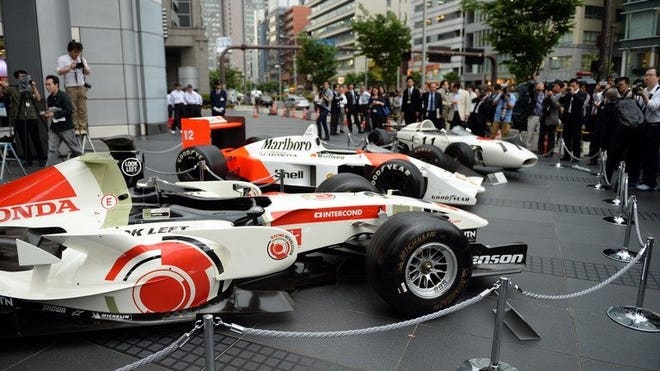
Honda to set up racing base in Milton Keynes


Japanese automaker Honda said it will build a European racing operations base in Milton Keynes ahead of its return to Formula One in 2015.

Honda said in May that it will return to the sport as an engine supplier to McLaren in a bid to revive their championship-winning partnership.

On Friday it said it will build a new facility in Milton Keynes that "will rebuild and maintain the power units developed at Honda (research and development) centre" in Japan.

"The UK is an ideal location; it is the home of McLaren, many F1 suppliers are UK based and with seven of the 19 races taking place in Europe (in 2013)," Honda said in a statement.

The Japanese automaker pulled out of F1 after the 2008 season, ending an involvement that began in the 1960s, to cut costs during the economic downturn that ravaged Japanese exports to the United States and Europe.

It sold its team to former principal Ross Brawn the next year.

A recent change in F1 rules, promoting the use of environmentally friendlier turbo engines, has made the comeback decision easier because Honda could readily transfer the technology to its commercial vehicles.

The McLaren-Honda alliance conquered F1 from 1988 to 1991 with Ayrton Senna and Alain Prost at the wheel.

Honda started racing in F1 as a full-fledged team in 1964, and stayed until 1968. During that time, it won two races.

Then, as a supplier of engines to other teams including McLaren, Williams and Lotus, it raced from 1983 to 1992 and won 69 races.

After an eight-year hiatus, Honda returned as an engine provider and then part-owner of the BAR team from 2000 to 2005. In 2006 it took full control and renamed it Honda.

SOURCE

Welcoming news from the Formula 1 scene after all the bad press about the safety issues regarding Pirelli tyres. Honda will not have its own team, unlike when it last pulled out of the sports in 2008. Instead, they will supply the turbocharged engines to teams like McLaren, one which they have past glories with in the late 80s and early 90s. It will be very interesting to see how Honda can help McLaren boost its position on the field.


Valets say cases of drunk patrons driving off are common


The scourge of drink driving looks like it is not going away any time soon, if The New Paper’s checks with valets at several nightspots are anything to go by.

Last weekend, we spoke to some of them at the Tanjong Pagar, Orchard Road and Boat Quay areas.

Five valets said it was not unusual to encounter clubbers who insist on driving themselves home, even when they had drunk too much.

Said a valet working in a club at Tanjong Pagar, who wanted to be known only as Mr Ameen: “We have customers who insist on driving themselves home after clubbing. I honestly don’t know why they take the risk. We charge them only $50 to drive them back, but if they refuse, we can only remind them that it is against the law as we can’t force them.”

Last year, the police arrested 2,917 people for drink driving.

This is a 6.6 per cent increase compared to 2,735 in 2011.

SOURCE

This is a very disturbing trend to reveal as we all know how drink driving can endanger other road users other than the driver himself. It is a very selfish act which should not be tolerated. It seems that people will only obey the law when they see the flashing red/blue lights.


Friday, July 12, 2013

More COEs to be made available from August 2013 to January 2014


More Certificates of Entitlement (COEs) will be available during the six-month period from August this year to January 2014.

The Land Transport Authority (LTA) said that it has set the quota at 20,825.

This is 1,562 more than the 19,263 made available from February to July this year.

For small cars, 728 COEs will be made available every month, up from 667 in the previous six-month period.

For big cars, the quota is 746 per month, up from 605.

The open category will have a monthly quota of 522, up from 476 in the previous six-month period.

For goods, vehicles and buses, 514 COEs will be available, up from 451.

The only category that will have fewer COEs is motorcycles. There will be 961, down from 1,012 in the previous six-month period.

On a monthly basis for all categories, 3,471 will be made available, compared with the previous quota of 3,211.

Bidding under the new quota will start with the August 2013 First Open Bidding Exercise.

The COE quota consists of several components:

• 0.5 per cent vehicle growth based on the vehicle population as at 31 December 2012
• Replacement COEs for vehicles de-registered between January and June 2013
• Adjustments for change in taxi population, expired COEs and over-projections of vehicle de-registrations in 2008/2009

SOURCE

A pretty small increase for the next 6months. I reckon this will not make much of a difference in the coming COE bidding prices. Demand for cars is still very high.


Friday, July 5, 2013

Hit & Run Lexus SGD5233H


It is a very serious offence to hit & run from an accident in Singapore. This accident further emphasize the importance and a need to install a in-car DVR to prevent the culprit from running away. Hopefully the driver of the video poster is alright and will get justice served.


Thursday, June 20, 2013

India's Tata Motors revamps world's cheapest car


India's top automaker Tata Motors unveiled a new version of what was once billed as the world's cheapest car Wednesday, in a bid to reverse a slump in sales.

The jellybean-shaped Nano, which sold for around $2,200 when its first edition went on the market in 2009, has seen sales drop by more than 27 percent in the last year and Tata's recently-retired supremo admitted the car had an image problem.

The compressed natural gas(CNG)-fuelled version of the Nano unveiled on Wednesday is expected to hit showrooms within the next 90 days, the company said.

Tata Motors did not disclose the CNG Nano price, but said it would be announced soon.

"This (CNG) is the first major variant for the Nano since its launch," auto analyst Mahantesh Sabarad of Fortune Equity Brokers said.

Sabarad said the CNG version is being introduced to "give customers a better choice" but may take away its "affordability" tag.

It was not immediately clear whether the Nano would retain its title as the world's cheapest car.

In an interview shortly before his retirement last December, the company's long-time chairman Ratan Tata said it had been a mistake to market the Nano merely on its low-price, saying "various stigmas have been attached to it".

Sales of the part-plastic Nano fell 27.7 percent in the fiscal year to March 2013, to 53,847 units, according to company data.

Since its launch, the Nano has had several small makeovers -- including upgrades to its interior and a doubling of the warranty to four years.

The unveiling of the CNG Nano -- called E-Max -- was part of a mega launch by Tata Motors at its factory in Pune where it also introduced new versions of its existing Nano, the hatchback Indica and Sumo sport-utility vehicles.

The enhanced Nano -- with features like remote locking and sleeker interiors -- will cost upward of 150,000 rupees ($2,580).

In recent quarters, Tata Motors' earnings have been boosted by the performance of its luxury brands Jaguar and Land Rover, which have compensated for its weak domestic car sales.

Automakers in India have witnessed an unprecedented seven straight months of lower car sales, due to a slowing economy and a rise in the cost of raw material.

In May, Tata Motors' total domestic passenger vehicle sales fell 45.69 percent at 11,134 units, from levels a year earlier.

"The market has been bad in the past two months but since then there has been some improvements," managing director Karl Slym told reporters on Wednesday, according to the Press Trust of India agency.

Tata Motors bought Jaguar and Land Rover from Ford Motor Co in 2008 for $2.3 billion as part of plans to expand its reach beyond Asia.

The deal vaulted Tata Motors from a commercial vehicle and small-car maker into a global player whose portfolio includes luxury brands.

SOURCE

So, having a cheap price is not all it takes to sell a car successfully. Consumers nowadays have grown out of this pricing affair thingy. Right now, value for money is the way to go. It is better to pay a little more to enjoy the simple luxuries in the car. Tata is fast to learn their mistakes and is good that action has been taken to rectify it. Not all car making companies learn from their mistakes so readily. Tata is commendable.


Certificate of Entitlement (COE) prices rose across the board for all categories.

In the latest bidding exercise, the COE price for the open category experienced the biggest jump -- rising by S$7,001 to hit S$83,001.

The next biggest jump was in the big cars category, with premiums going up by S$6,751 to S$81,751.

The premium for small cars went up S$2,602 to S$69,903.

COE prices for commercial vehicles rose S$1,012 to hit S$59,001.

As for motorcycles, the COE price went up by S$11 to reach S$1,712.

From next month, the government will start imposing registration surcharges on cars with high carbon emissions under the new Carbon Emissions-Based Vehicle Scheme (CEVS).

Buyers of such cars will have to cough up between S$5,000 and S$20,000.

Motor traders said car buyers who wish to avoid the penalties are driving up COE prices in the latest bidding round.

Neo Tiam Ting, president of the Singapore Vehicle Traders Association, said: "The CEVS come in not only for Category B vehicles but for all vehicles, but Cat B vehicles will be affected more. Those in Cat B, those with high-capacity cars will be affected more, that's why the COE goes up more than A."

Motor traders said higher prices for big cars are also due to the perception that authorities will be fine-tuning the categorisation of COEs to further segregate higher-end models from cheaper ones.

Eddie Loo, managing director of CarTimes Automobile, said: "After the re-categorisation, I think it will put much more pressure on Cat B. So I think for the luxury cars, premiums will still be going up. Before they reach S$100,000, I think it is better to go into the market first."

The public has until July 7 to give their suggestions on ways to refine the COE system.

SOURCE

New rulings are forcing everyone to jump into the market now causing a relatively huge jump in premiums across the board. The Cat B buyers will be experiencing very high premiums until the rulings are finally in place. For now, let the figures rise.


Sunday, June 9, 2013

Used-car dealers, small firms not jumping on car leasing bandwagon


Most used-car dealers and small motor firms Channel NewsAsia spoke to are not jumping on the car leasing bandwagon, despite bigger players getting in on the act since the authorities imposed borrowing limits on vehicle purchases.

They cite high costs of running a leasing business and unfamiliarity with how to do it as reasons.

Still, a few are eyeing the business model as an alternative to car sales.

Car leasing schemes are a mid-point between short-term rental and ownership, where you typically hold on to a vehicle for over a year and pay a monthly fee to use it.

The car goes back to the leasing company after that.

Not being stuck with a depreciating asset like a vehicle has drawn people to the scheme, plus the fact that a sizeable downpayment isn't needed.

The government's imposition of loan curbs means buyers have to foot a minimum 40 per cent downpayment for vehicle purchases.

Observers have noted that car leasing is one way of beating the curbs. Others call it an option.

Eddie Ho, general manager of Sime Darby Services, said: "It's not a way to beat the government's system but it's just another alternative for motorists to consider, because there's no way we can beat the system.

"Ultimately, leasing...to me is like another dish on the menu for the companies to sell."

Not all motor firms are keen on leasing, since much of the onus falls on the leasing company to keep leased vehicles in order.

Many companies simply don't have the resources to do it.

Still, some plan to capitalise on the opportunity.

CarTimes Automobile plans to starts a leasing arm in June 2013 while Yong Lee Seng Motor has been dabbling with leasing for around three years.

Raymond Tang, Yong Lee Seng's director, said: "The difficulty of doing it is that a lot of follow-up, a lot of support you need to give to these consumers. Or else, the consumers will not be happy...what happens if the car breaks down in the middle of the night? You must have workshop support."

Observers note that the government's "car-cooling" measures have shifted more attention to the leasing business, although it has been around in Singapore for over a decade.

SOURCE

A way to beat the system for aspiring "car owners". You can have a car but save the hassle of 100% owning the car. It's a viable option if one is unable to fork out the huge downpayment needed according to the new ruling by MAS.


Sunday, June 2, 2013

69% of used cars eligible for full loans sold


About 69 per cent of used cars eligible for full loans have been sold as of 27 May since authorities lifted borrowing limits for buying those cars for 60 days.

This concession will last till Tuesday.

Motor firms are bracing for uncertainty thereafter.

Dealers whom Channel NewsAsia spoke with expect the market to be even quieter, with car loan curbs in full force.

To help used car dealers clear old stock acquired before new borrowing restrictions were introduced, a two-month concession was given. This meant that buyers could continue taking up to 100 per cent loan for vehicle purchases.

The concession applied to some 7,000 used cars. Over 4,800 have been sold so far.

Classic Credit had around 180 vehicles from old stock. About 170 have been sold, but customers remain cautious.

Andy Ong, sales consultant at Classic Credit, said: "It all depends, you see, on the customer preference - what they want. Because mostly for used cars, they are going for those budget cars. Talking about high-end, they should rather go for the new cars right? Because those people are those well-to-do families."

Prospective car buyer Clarence Pang said: "Actually, I'm just checking out the cars, just looking at the value… maybe if the price is good, (I will) get it, or if not, just hold on."

Freddie Yap, also a prospective car buyer, said: "I will never, ever sign any papers to buy a vehicle over S$100,000."

Dealers are not expecting things to get any better, especially when car loan curbs for used cars kick in.

Companies have been downsizing operations or have moved out entirely, due to slowing business. Yet, others will see opportunity.

Taking up empty spaces are commercial vehicle sellers as they are unaffected by loan curbs.

Kenson Goh, sales executive at Car Design, said: "Most car dealerships will actually shrink. From maybe about four fronts to maybe about one or two fronts only. So definitely, a lot of people are cutting costs."

To ease the situation, the Singapore Vehicle Traders Association hopes authorities can raise borrowing limits from 60 to 80 per cent. It said this will reduce downpayment obstacles preventing some from buying a car.

SOURCE

In a blink of an eye, 60 days is almost up, and 69% of the stock have been cleared. There are still a good 2000 of them unsold as of now I guess, so if you're still pondering on your second hand car purchase, I guess it's about time you head down and see if there's anything worth your dough.

The dealers should be slashing the prices or they might never be able to offload these 31% sitting in the showroom. The next COE bidding will be more interesting.


Saturday, June 1, 2013

SMRT needs to carry out more stringent checks on rails: LTA


The Land Transport Authority said it will require SMRT to carry out more stringent checks and replace the running rails earlier where necessary.

It issued a statement following the fourth incident of a rail crack that has occurred on the North-South/East-West Line in recent weeks.

LTA said it is concerned and is investigating the root causes of the incidents.

During a joint news conference by the LTA and SMRT to address the issue of rail cracks, SMRT said that it has completed ultrasound checks on all rail joints in the system, and no other defects have been found.

As some of the cracks are symptoms of an ageing rail network, more may be expected in the future. However, LTA said safety of passengers will not be compromised.

Deputy chief executive of the LTA, Chua Chong Kheng, said: "This is because the signalling system that we have is designed to detect rail cracks, and when the rail cracks, it will be treated as though the track is occupied. Therefore, other trains are prevented or not allowed to come in to that area."

LTA added that it is too early at this stage to determine if there is any underlying link or systemic issues that contributed to these four recent rail cracks.

LTA also said SMRT, which operates the North-South/East-West Line, has a system of running rail replacement similar to the approach adopted by operators in other cities -- whereby individual running rail segments are replaced when there are defects, or when the wear and tear for that rail segment warrants it.

But due to the recent incidents, SMRT will be taking various precautionary measures. These include accelerating its rail replacement programme.

Lee Ling Wee, senior vice president of rail services at SMRT, said: "In the past, we used to wait until the wear is 14mm before we replaced the rail. Now, instead of 14 mm we are shortening it to 12 mm.

"This means we are replacing it earlier, and that would mean additional maintenance efforts. We are in discussion with LTA for resources that we will need to increase our capacity for replacing the rail."

These resources include additional workshops to pre-fabricated rails.

SMRT said it has identified 40km of rail which need to be replaced -- the Nort South-East West Line has a total of 400km of rail.

Mr Lee added: "If we do not increase our capacity, it may take up to five years to replace the rails, but if we do increase our capacity, we are hoping to reduce it to two years."

LTA said that although the rail network is ageing, a complete overhaul is not necessary.

Mr Chua said: "Now, because the rails do not wear at the same limit throughout the whole railway, some stretches will wear faster -- for example at curves. So therefore, the replacement must be done on a basis where there are instances of the wear limits.

"The other occasion where rail is required to be changed is where there are defects that are found. For example, where there are cracks or corrugations on the rail head or the rail surface."

The LTA said it is monitoring SMRT's remedial actions very closely. It is stepping up audits on SMRT's maintenance works -- up from monthly to fortnightly -- to ensure checks are done thoroughly.

LTA will focus its audits on the track curves, as the recent rail cracks have occurred along such stretches.

To better determine what further measures can be taken to address the situation, LTA will be appointing an international trackwork specialist to assess the condition of the rail and to advise on possible changes to the operator's running rail maintenance regime.

SOURCE

Not very assuring eh? A crack track is not one to be meddle with. Any physical defect with it will cause a derailment if serious, and if there is such a day in Singapore's history, it will be very ugly judging by how crowded are our MRT trains. The authorities will have to take this seriously and keep a very close watch on SMRT.